The Way on the Bottle
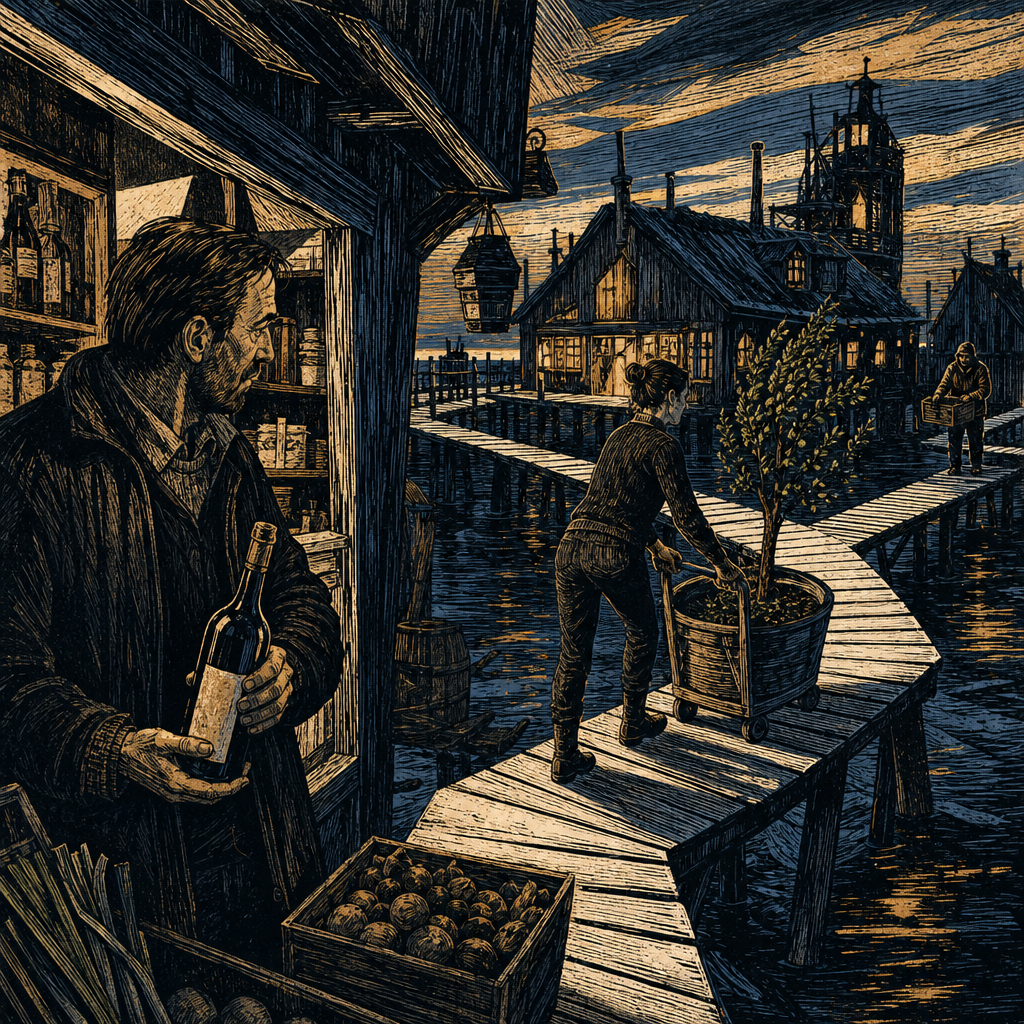
Alden Mori was paying for the plum ale when he noticed the lane.
Sibyl Kuroda had set the bottle on the counter among wick pellets, packets of sea beans, repair thread, and two salt-stiffened postcards bound for the upper terraces. The shop was full of damp coats and queue noise.
“Return sleeve included,” Sibyl said in English. “Don’t peel it off. The co-op counts bottles by sleeve now.”
“I know how bottles work.”
“You know how you prefer bottles to work.”
He turned the dark glass in his hand. The pale waterproof sleeve was printed with fine blue lines. Usually it showed return stations, brewing dates, and a little picture of plums. This one showed Wellenbruch’s lower ward in practical civic style: footways, pumps, tide gates, communal roofs.
Alden tilted it toward the window.
There, running from the shop’s west wall to the north door of the Tideglass, was Silt Lane.
Everyone over forty knew Silt Lane, though fewer each year had reason to mention it. It had once been the quick way to the pub: past the bent willows, alongside the old pumping house, over a short timber culvert, then into Daichi Bell’s back entrance. The sea had taken the culvert twelve years ago. Now the lane ran twenty meters through reeds and tidal water before becoming nothing at all.
Beyond the shop rail, Alden could see the dark bristle of reeds where it ended.
“This is an old one,” he said.
Sibyl took the bottle, turned it once, and her calm face tightened.
“Wrong print run.”
“It’s got the old culvert on it. Silt Lane all the way through.”
Someone near the bread cabinet had begun disputing a delivery weight. A boy was feeding a coin sideways into the drinking-water machine.
Sibyl lowered her voice. “Der Weg gilt nur, wenn du ihn kennst.”
Alden knew enough German for signs, labels, and stubborn neighbours. Way. Valid. Know.
“Legal access?” he said. “It still counts on paper, but the district won’t maintain it.”
Sibyl gave him a look that might have been impatience or alarm.
Then a woman by the door called, “Frau Kuroda, this receipt says I owe for two batteries.”
“No, it says you returned two. Wait.”
Alden slid the bottle into his coat pocket. The map showed Silt Lane cleanly, its bends precise enough to walk by. He paid and stepped into the blue-black evening.
The raised public walk to the Tideglass ran east, then north around the flooded district. At that hour it was clogged with people coming down from the shuttle platform before the evening water-rise.
Silt Lane lay directly ahead.
Under the shop awning, Alden studied the sleeve.
Shop wall. Three bent willows. Red pump housing. Culvert. North door.
There had been no need to look at it like that when it existed. You walked it because it was there. But Alden had been a dock tallyman for thirty years. He trusted sequences. A route was what came after the last thing.
He went west.
At first he found only old paving under salt grass. The first stones were firm. So were the next. The lane turned around the third willow exactly as the printed line did.
The tidewater should have begun after that.
Instead, the paving continued: cracked flagstones with familiar pale shells pressed into them, their joints tight and dry. His boots made the confident sound of leather on stone.
At the red pump housing, he stopped.
Beyond it lay the channel where the culvert had been. On the sleeve, a narrow black line crossed it.
Alden looked down, then followed the line straight on.
Boards waited there: gray timber fitted between two dark stone lips. When he stepped onto them, they gave a hollow, echoing knock.
A maintenance rider on the public walk saw him and braked hard. Her service trike rocked on its broad wheels.
“Hey! Sir! Don’t go in there!”
Alden turned, bottle in hand. The woman was looking past him at the water. Her face had gone white.
“It’s all right,” he called. “Old footing.”
“There is no footing!”
“Then you’re not on it properly.”
The boards held. On the far side, Silt Lane resumed in weeds and old paving, rising toward the Tideglass’s crooked back wall.
He arrived at the north door with dry boots, dry cuffs, and the plum ale unbroken.
Daichi Bell was polishing glasses at the back counter. The Tideglass had filled early, as it did whenever the evening barriers threatened to close.
Daichi looked up. “You cut through?”
“Silt Lane.”
The cloth stopped moving.
Alden brought out the bottle. “Before you say I’ve been drinking it, look at the sleeve.”
Daichi leaned forward to read it. His expression was not surprise. It was the look of a man finding a dripping umbrella on a polished floor.
“Sibyl let that out?”
“She tried to tell me it was legal access.”
“She did not.”
“She said something in German.”
“That may be worse.”
“The lane’s open. I walked it.”
Daichi came around the counter and lowered his voice.
“Don’t lend that route as a spoken shortcut. Don’t hurry anyone along it who hasn’t looked at it properly. And don’t tell people a usable way is a repaired one.”
Alden laughed. “If something carries a man and a bottle from point A to point B, it’s a way.”
“That doesn’t make it public infrastructure.”
“What does it make it?”
Daichi glanced at the sleeve. “Something Sibyl should have caught before the bottling machine did.”
The back door opened on a gust of damp air. Fenna Lenz came in sideways, shouldering a bakery crate. Flour clung beside one eyebrow; her hairnet had slipped down one side of her face.
“The shuttle’s gone,” she announced in German.
Daichi looked at the clock.
“It left early. Water schedule changed.”
“Last one?”
She nodded. “The barrier crew says the upper walk closes in forty minutes. I can take the eastern spine, but I’ll reach home after it shuts.”
Alden looked at the sleeve. Fenna lived in the lower west district, beyond the shop and the flooded cut.
“Silt Lane,” he said.
Daichi shut his eyes briefly.
Fenna looked between them. “Silt Lane is water.”
“Not tonight. I came through.”
“Sit down,” Daichi said.
“What?”
He pointed to a table beneath the front window.
Fenna set down her crate. Outside, under the awning, stood a small wheeled tub with flaking blue paint. A dwarf pear tree grew from it, no taller than Fenna’s shoulder, its thin branches tied against the wind. Several green pears hung among the leaves.
Alden nodded at it. “What’s that doing here?”
“Orchard rotation. The Hasegawa house had it last month. My aunt’s terrace gets it next.”
“You can leave a tree under Daichi’s awning for one night.”
“No.”
“It has wheels.”
“It also has roots.”
Daichi laid the bottle sleeve flat on the table and handed Fenna a grease pencil.
“Trace it.”
Alden frowned. “She can see it.”
“She needs to know it.”
Fenna put the pencil at the shop symbol.
“Shop wall,” Daichi said.
She drew along the route.
“Three bent willows. Red pump housing. Culvert. North door.”
Her hand moved slowly at first, then with more certainty. Alden shifted from foot to foot.
“The water’s rising.”
“Exactly.”
Fenna traced it again, naming the points herself, first in English, then quietly in German. At the culvert she paused, gaze fixed on the sleeve.
Daichi tapped the map once.
“覚えた?”
Fenna looked up. “覚えた.”
He nodded toward the door. “じゃ、行ける。”
They went out together.
The pear tub’s wheels complained over the pub paving. Fenna took the handle; Alden carried the bakery crate. Where the lane narrowed, they each gripped one side of the tub and lifted it over a broken edge of stone.
“North door,” Fenna said.
“We’re at the pub.”
“I know. I’m starting it from this end.”
She studied the sleeve once more, tucked it into her rain jacket, and led.
The lane was there.
Alden felt an unreasonable pleasure in it. The three willows bent westward in the salt wind. The red pump housing stood where it should. The paving remained worn and neglected, but under his feet it had the solid exactness of a ledger entry.
Fenna moved without hesitation. The pear tree trembled in its tub as they rolled it along. The crate grew heavy in Alden’s arms, but he did not complain.
At the pump housing, a delivery cyclist came along the raised boardwalk from the east, pushing a loaded electric cart.
“Is that Silt Lane?” he called.
“It is,” Alden answered. “Keep the pump on your left, straight to the culvert, then shop wall.”
The cyclist stopped at the rail.
Water lay black between them, lapping through reeds where Alden could see the paved route.
“There’s no crossing,” the cyclist said.
“Of course there is. We’re standing on it.”
Fenna had reached the culvert. She set one wheel of the pear tub onto the first gray board. Alden stepped beside her, balancing the crate. The boards answered with their deep hollow knock.
The cyclist took one step down from the public walk and stopped abruptly. His boot sank into reed-mud to the ankle.
He swore, not loudly.
“You’ve missed it,” Alden called. “A little left.”
The cyclist stared at the water.
Fenna did not look back. “Culvert,” she said to herself, and drew the pear tub across.
Together they crossed. The boards were dry beneath their feet; water rippled close on either side, breaking the reflected lights.
Behind them, the cyclist backed onto the boardwalk and turned his cart toward the eastern spine.
By the time they reached Sibyl’s shop, the first barrier shutters were descending at the far end of the lower street. Water-rise lamps pulsed amber along the posts.
Sibyl stood in the doorway, arms folded into her work jacket.
She looked at Alden, Fenna, then the pear tree.
“You took the tree.”
“I told him it had roots,” Fenna said.
Sibyl softened by a degree. “So it does.”
Alden set the bakery crate inside. Fenna wheeled the pear tub beneath the awning, where its leaves shook off bright drops.
Sibyl held out her hand.
“The sleeve.”
Fenna took the sleeve from her jacket pocket and gave it to Alden. He handed Sibyl the bottle from his coat pocket along with the sleeve. Sibyl inspected the pale map once, then folded the sleeve carefully away.
“Hey,” Alden said. “That’s the useful part.”
“It is the incorrect part.”
“It got us across.”
“It got you across.”
“And Fenna.”
Fenna rested one hand on the pear tub’s handle and said nothing.
Daichi arrived from the pub side by the raised walk, breathing evenly. He nodded to Sibyl. She folded the sleeve into quarters, then into a small square, and slipped it into a locked return drawer beneath the counter.
“You ought to print more,” Alden said. “We’ve got a lane again. Tell the village. People have been wasting half an hour going around.”
Sibyl looked at Daichi over the counter.
“Tonight,” Daichi said mildly, “people can use the raised walk.”
“Nonsense. I’ll tell them the exact way.”
Outside, the delivery cyclist reached the shop by the long route. His cart wheels hissed on the wet boards. He paused beneath the awning, tired but unharmed.
Alden brightened. “There you are. Quick road home: start at the shop wall, take the three bent willows, then the red pump housing. Straight over the culvert.”
The cyclist listened politely. He glanced past Alden toward the reeds and flooded darkness, then at the descending shutters. He put both hands on his cart.
“Thank you,” he said. “I’ll take the spine.”
He wheeled away along the raised walk.
Alden shook his head. “People don’t trust a good route when they’re handed one.”
Fenna stood beside the pear tree, looking west. From the shop threshold, Silt Lane ran in a narrow dry line between dark water and reeds, all the way to the crooked glow of the Tideglass.
She tightened her hand around the little handle.
The barrier shutters reached the ground with a final, practical clatter.