The Phlogiston Chair
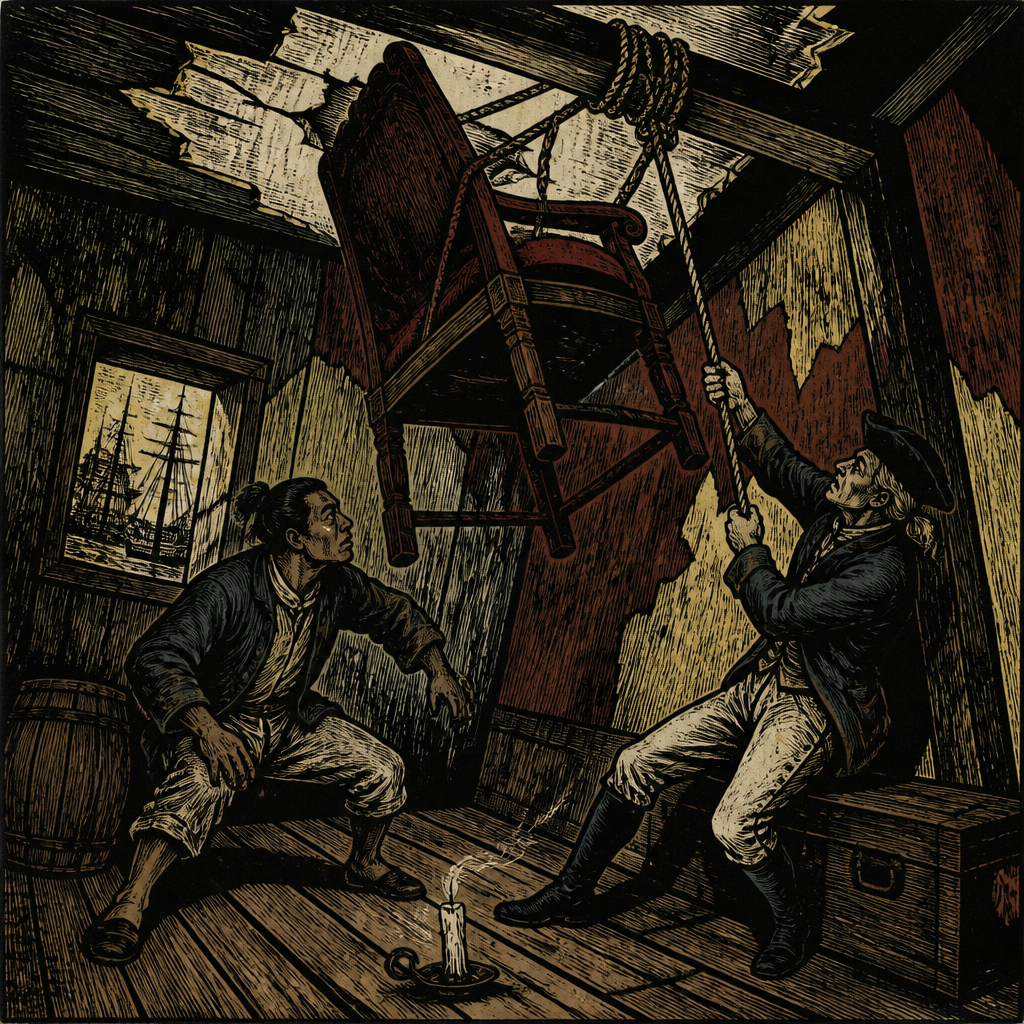
“Not that door,” Anselm Bracht said.
“It is this door.” Iori Senda set his shoulder against the warped planks. “The tally says forty-seven.”
“The tally is your hand, Senda.”
“It is my hand, yes. The chair is still inside.”
Behind them the Pregel slapped at the lower quay steps, one black rung at a time. Beyond the warehouses, masts shifted. The Mercy Bell lay in the channel with her topsails loose, her boat already stowed.
Anselm had the bonded-store key, a broad iron thing on a tarred string. He looked at Iori, then at the water.
“One berth,” he said in German. “Mara said it plainly.”
“One chair aboard before the tide reaches the lower quay.”
“And the man who manages it keeps the berth.”
Iori did not answer. His German was good enough for orders, knots, prices, insults. Not, he thought, for every shape of contempt in Bracht’s face.
The lock gave. The door opened upon stale dark, hemp dust, old pine crates, and cured leather. Iori ducked in first, found the chair by touch, and dragged it clear of a stack of wool bales.
It was the captain’s cabin chair: walnut, high-backed, with a carved sea-horse crest and brass studs along its faded red leather seat. Captain Bell had brought it from London ten years before and would sooner have sailed without a compass than without it. Iori had marked its unloading slip for Store Forty-Seven instead of the customs shed by the western crane. The chair had vanished among a hundred lots until that morning.
Mara Clevett had heard his explanation with her lips pressed thin.
“Fetch it,” she had said in English. “The flood tide takes us at noon. Chair aboard before it reaches the lower quay, and one of you has a winter berth. Fail, and I’ll find men in Danzig.”
Anselm took a candle stub from his pocket and lit it with his tinderbox.
“Look for the plate,” Iori said.
“You know it is the captain’s.”
“Then prove it.”
Bracht swore, but held the candle low. Iori knelt, found the little brass plate beneath the seat rail, and rubbed dust away.
BELL & HARP, WAPPING.
The chair made a small sound.
Not a creak. More like a boot sole unsticking from wet mud.
Iori looked down.
The front legs no longer touched the floor.
Bracht saw a moment later. He shoved the chair’s arm.
It moved upward, light under his hand.
“What have you done?” he demanded.
“Nothing.”
“Your mistake, your chair.”
“I did not make it float.”
The rear legs scraped, then left the boards. The chair rose slowly, straight-backed and composed, as if an invisible servant had taken it by the rails. The candle flame bent toward it.
Iori caught one leg. It pulled against his grip with the steady force of a hauled line.
“Hold it,” Bracht said.
“I am holding.”
“Hold it down.”
“I know that word.”
The chair rose another hand’s breadth. Its sea-horse crest touched the low plaster ceiling. Dust sifted over Iori’s hair.
Bracht thrust the candle close beneath the seat. “There is a bladder in it. Some English trick. A spring. A gas skin.”
“Then cut nothing yet.”
The chair pressed harder overhead. The crest began grinding a pale half-moon into the plaster.
Iori braced his feet and hauled. Bracht seized the other front leg. Together they pulled until their shoulders shook. The chair halted only because its crest had met resistance.
“Put out the candle,” Iori said.
Bracht stared at him.
“Put it out.”
Perhaps because the chair was chewing the ceiling above them, Bracht pinched the flame between wet fingers.
Darkness dropped around them.
The chair stopped.
Its crest remained pressed into the plaster. Iori could feel the pull in his palms, but it no longer increased.
Bracht struck tinder again.
The candle kindled.
At once the chair gave a hard upward twitch. White grit fell into Iori’s eyes.
Bracht extinguished the candle.
Outside, a cart rattled over cobbles. The tide struck the pilings with a thicker sound.
“Light makes it rise,” Iori said.
“You saw that.”
“It proves enough not to light another candle under it.”
Bracht felt along the wall. A crate scraped. When he had dragged it beneath a high, filthy window, a thin grayness entered the room. They could see the chair’s legs hanging above their heads and the rope coils by the door.
“Rope,” Bracht said.
They passed a line around the chair’s front rail and threw the bitter end over a warehouse beam. Bracht took three turns around a post. Iori held the loose end.
They pulled together.
The chair descended half an inch. The rope groaned; the upward force went into the beam above them.
“It has air in it,” Bracht said. “The flame heats it.”
“Then why did it stop when the flame stopped?”
“Because it cooled.”
“It stopped at once.”
Bracht’s face was pale in the window light. “You have another thought?”
Iori remembered Russian riverboats, men in stiff coats disputing airs and fire-matter. A thing burned, and something left it; that much had seemed plain. The old men had talked as if fire left a substance behind in iron, wood, earth.
“No,” he said. “Not one I can say well.”
Bracht looked at the cut leather seat.
“If it is vapor, it is in there.”
“Anselm—”
“We must know what carries it.”
His knife slit the red leather across the front edge. Horsehair spilled out in a dry curl. Under it lay black, crumbly packing unlike ordinary stuffing: charred wood, crushed charcoal, flakes that left soot on Bracht’s fingers.
“What idiot stuffs a captain’s chair with this?”
“It smells like a brazier.”
“English furniture.”
“Do not burn it.”
Bracht had already taken a pinch between finger and thumb. “If it catches, we know.”
“We know flame makes the chair rise.”
“We know flame does something.”
He struck tinder.
The shaving took reluctantly. It glowed red, then showed a blue-yellow edge.
The chair slammed upward.
The rope snapped taut. The ceiling cracked from the sea-horse crest to the window wall with a sound like a pistol shot. A lath broke free. The chair twisted; its rear leg hooked the rope, and the line tore a shelf from the wall.
Boxes rained down: chipped cups, brass buttons, account books, a painted wooden bird on wheels with one red wing broken away.
Bracht threw himself aside. Iori hauled the rope with both hands. The chair dragged him forward until his knees struck the boards.
“Out!” he shouted.
Bracht crushed the glowing shaving beneath his boot.
The chair ceased its jerk, but had gained another foot. Its crest was buried in cracked ceiling plaster. The rope thrummed.
For a while they heard only their breathing and plaster grains settling.
Then Bracht said, “Phlogiston.”
Iori looked up.
“My father was a cooper. He had books.” Bracht kept his eyes on the chair. “Things that burned gave off phlogiston. The learned men laughed at him. Said air had other names now.”
“The fire-stuff.”
“That is the word.”
“It leaves burning wood. Goes into the chair.”
“Not every chair.”
“The charcoal.”
“Maybe.”
“The closed room.”
Bracht glanced toward the shut door. “Maybe it cannot escape.”
Iori looked at the dead candle, the black stuffing, the chair hauling against its rope. The old explanation was foolish. Yet here was a chair taking fire’s leavings and becoming lighter with every flame.
“Phlogiston,” he said.
The word gave them no comfort. It gave them a handle.
Bracht retied the rope lower, around a thick floor ring once used for cargo winches. Iori found a bucket beneath a cloth sack. There was water in it, brown but sufficient. They tore strips from sacking, soaked them, and laid one over the slit seat.
“We need light to work,” Bracht said.
“We have the window.”
“Not enough.”
“Then no work that needs light.”
The tide boomed beneath the quay.
Mara’s voice came through the door.
“Senda! Bracht! Tide’s on the pilings!”
Iori answered in English. “We have it!”
“You have five minutes before the lower steps drown!”
“Five minutes,” Bracht said in German. He looked toward the narrow doorway. Even on the floor, the chair had barely passed through sideways. Now its crest was caught in the ceiling and its legs hung above reach.
“We take it into open air,” Iori said.
“And it stops?”
“The room keeps it.”
“You know this?”
“No. But outside the smoke can go.”
“Open air may not stop it.”
“Then the Mercy Bell has no chair and neither of us has work.”
The rope gave a small complaint overhead.
“First darkness,” Iori said. “No candle. Then we lower it. Rope around it, let it pull against us, guide it through the door.”
Bracht rubbed plaster from his sleeve. “We leave it tied to the beam. Fetch dock men with lamps and hooks.”
“More lamps. More time. More people seeing it.”
“And you think she gives you the berth for this?”
Iori did not answer.
Bracht stepped closer. “You want to be the clever foreign sailor with the captain’s flying chair.”
“I want to leave this room.”
“You made the error.”
“Yes.”
“You should lose the berth.”
“Perhaps.”
The word surprised them both.
Iori put a hand on the chair’s dangling rail. It trembled under the rope’s tension. He remembered his mother’s voice from a shore he had not seen in years, when a storm had broken their shutters and he had wanted to run into the rain after a bowl.
もったいない, Iori.
Do not throw away what can still serve.
He began making a bowline.
“What are you doing?” Bracht asked.
“Giving it weight.”
“With rope?”
“With me.”
“That chair will lift you into the roof.”
“Then hold the rope.”
Bracht caught his arm. “No.”
“The rope already holds it. I climb the frame. You let it down. When it reaches me, keep it from rising again.”
“In the dark.”
“Yes.”
“You will be crushed.”
“Only if you are slow.”
Bracht’s grip tightened, then released.
They worked by the window’s failing gray. Iori looped the bowline around his waist and the chair’s side rail, climbed the broken shelf, and stepped onto the chair’s side rail. It rose beneath him at once, taking his weight until the rope caught.
Bracht stood at the floor ring, line wrapped around his forearm.
“There may still be a coal,” Iori said.
“Under the wet cloth?”
“Douse all of it.”
Bracht poured the bucket over the slit cushion. Water struck charcoal with a soft hiss. Damp ash and old chimneys rose in the smell.
The light from the window narrowed as a cloud crossed the harbor.
“Now,” Iori said.
Bracht kicked the crate aside.
With the cloud over the window, the room was almost black.
At first nothing happened.
Then Bracht hauled in the rope.
The force that had held the chair aloft did not vanish; it no longer increased, and Bracht’s pull, Iori’s weight, and the soaked stuffing took command. The crest tore free of the ceiling. The chair dropped a hand’s breadth.
“Hold!”
Bracht hauled in more rope.
The chair sank faster. Iori’s shoulder struck the beam above. He ducked as the carved crest swept down past him.
The rope slipped against Bracht’s arm.
For one instant Iori hung unable to breathe, twisted between the beam and the hard wood of the chair. If Bracht let go, there would be no berth to argue over.
Then the line jerked tight.
Bracht had thrown his whole weight backward. His boots skidded across the boards. The rope bit through his shirt sleeve into skin, but it held.
“Get off!” he shouted.
Iori twisted aside, found the shelf stump with one foot, and dropped clear. Bracht lowered the chair in short, shaking increments until its legs struck the floor.
It did not rest heavily. It stood with an odd soft pressure, as if the boards disliked having it.
They tied its legs together and ran a rope from crest to rear rail. Without a flame, they lifted it sideways. Its lightness made it harder to manage: each shove sent it drifting toward the ceiling or turning into the wall.
Bracht took the front. Iori took the back.
“Left,” Bracht said.
“Your left?”
“Door left, idiot.”
They edged it past the fallen shelf. The crest scraped the lintel. Iori lowered his end; Bracht raised his. For a moment it jammed crosswise in the narrow opening, legs straining against their ropes.
Outside, Mara shouted again.
“The water’s over the lower step!”
“Push,” Iori said.
“I am pushing.”
“Not up.”
The chair slid through.
Cold harbor air rushed over them.
The change was not immediate enough to be mercy. The chair tugged upward, pulling the ropes taut between their hands. But within a few breaths the pull grew less fierce. By the time they cleared the threshold and set it beside the quay wall, its front legs barely brushed the stones.
Mara Clevett came running from the water stairs, coat open, black hair escaping its tie. Two Mercy Bell hands waited behind her with a handcart.
She stopped at the store door. The cracked ceiling, torn shelf, and ragged rope loop were plain in the harbor light. Then she looked down at the chair.
Iori held one arm. Bracht held the other. The chair was still trying, faintly, to rise between them.
“What in God’s name have you done?” Mara said.
“No fire near it,” Iori said in English.
“That is not an answer.”
“It is the important part.”
The tide slapped against the quay stones. The lower stairs had vanished beneath brown water.
Mara touched the carved rail. It rose against her palm with the pressure of a thing drawing breath.
Bracht spoke in German, fast and flat. Mara caught only pieces. Iori supplied the rest: candle, charcoal, closed room, ropes, sudden lift. He did not say phlogiston until the end.
“Phlo—what?”
“Fire-stuff,” Iori said. “It takes it. In close air.”
“That is nonsense.”
“Yes.”
Mara looked toward the brig. “Can it be carried?”
“With ropes.”
“Can it go in the captain’s cabin?”
“No flame.”
“Captain Bell keeps a lamp there.”
“Then not cabin.”
Bracht let go of the armrest long enough to show the bleeding groove around his forearm. “You promised one berth.”
“We both brought it out,” Iori said.
“You both nearly pulled down a bonded store,” Mara replied.
The chair lifted another inch, then settled as the open air leeched away whatever it had taken. Iori watched it and thought of the Mercy Bell’s signal halyards, of wet lines jamming in bad weather, of men climbing rigging in sleet.
“It can work,” he said.
Mara gave him a hard look. “Work?”
“In a shuttered lamp room. Tie it to a signal line. Small candle, exact time. It raises the line without a man going aloft.”
“That is your proposal?”
“Yes.”
“And who tends an impossible chair in a wooden brig full of tar, lamp oil, and men who smoke?”
“I do.”
Bracht barked a laugh. “He will sleep with it.”
“I will,” Iori said.
The ship’s bell sounded once across the water.
“You get the berth,” Mara said. “Not as an able sailor only. As keeper of the chair. You sleep in the forward lamp compartment beside it. You light no flame except by my order and keep a written allowance of every candle-end. If it lifts so much as a spoon without your hand on the rope, I put you ashore at the next port.”
Iori nodded.
“And Bracht?” Bracht asked.
Mara looked at the damaged store, then brought a small purse from her coat.
“The warehouse clerk will want coin. Take this to settle what you broke, or come aboard without a berth and explain the matter to Captain Bell yourself.”
Bracht took the purse. It made a small sound in his large hand.
For a moment Iori thought he would throw it into the water.
Instead Bracht looked at the chair, the rope burn on his arm, and Iori.
“You had better keep the thing dark,” he said in German.
“I will.”
Bracht turned toward the customs office.
The Mercy Bell’s men loaded the chair onto the handcart. Even in the wind off the river it tugged faintly at its lashings. Iori walked beside it with one hand on the rope.
At the gangplank, Mara said, “Senda.”
“Yes?”
“If your fire-stuff burns my ship, I’ll drown you before the water does.”
“Yes, Miss Clevett.”
He helped guide the chair aboard.
Below decks, they made a place for it in the shuttered lamp compartment, away from the captain’s cabin and galley, with fresh rope through iron rings and a bucket always full beside the door. Iori tested each knot twice. Then he sat on the floor beside the chair as the brig began to move with the flood tide.
Above him, boots crossed the deck. Lines creaked. The harbor opened.
The chair tugged once against its lashings.
Iori put his hand on the rope and kept it there.