Der letzte Begleiter
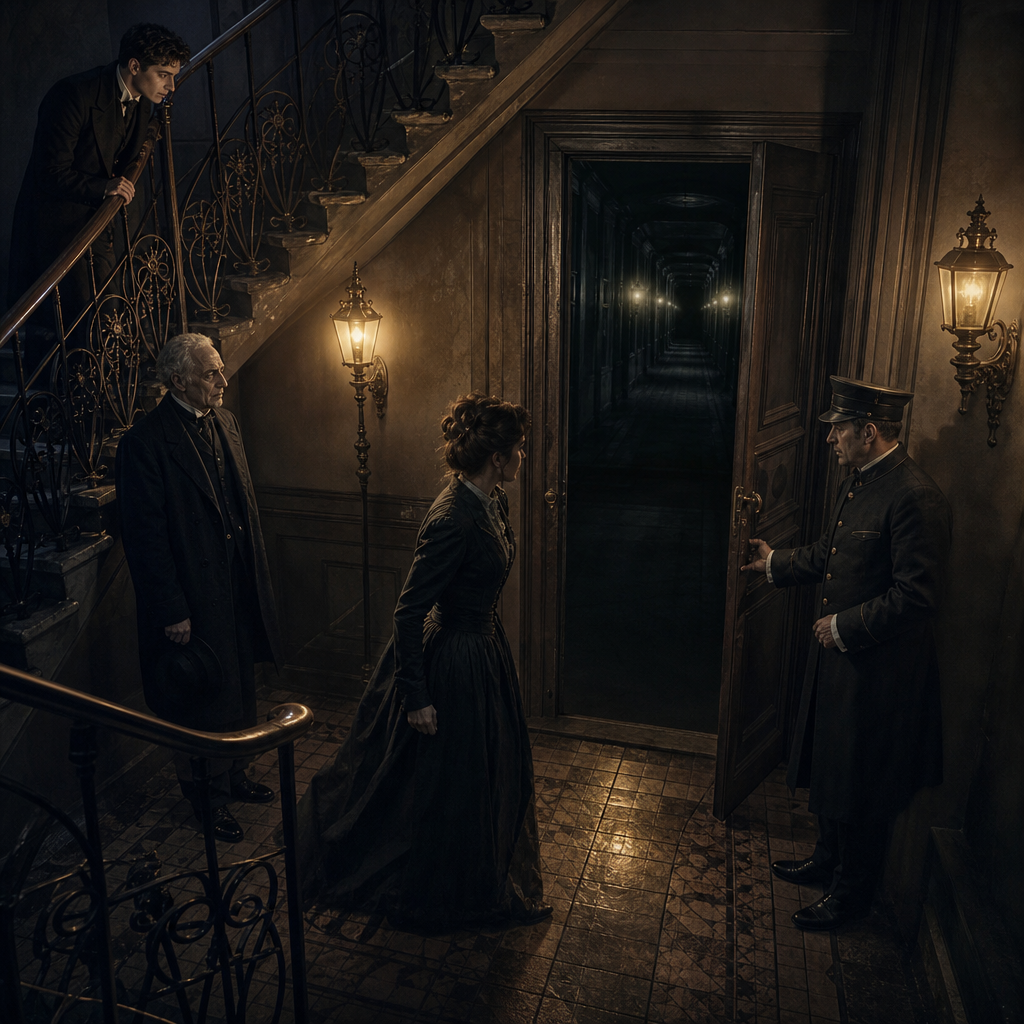
At half past ten Johanna Mertel laid down her pen, flexed the ink-stained fingers of her right hand, and counted the sheets remaining in the packet.
“Eight.”
From the kitchen Kaspar answered, “Then you may have tea before midnight, if Heaven is merciful.”
“Heaven has no concern with affidavits.”
“It ought to. They are a punishment for sins not yet committed.”
He appeared in the sitting-room doorway with the teapot in both hands. He was twenty-two, broad-shouldered and fair-haired, with the injured air of a boy who had expected the world to discover his usefulness and had instead been dismissed from a shipping office after three months. Johanna no longer asked whether he had called anywhere that day. He no longer asked how many pages she had copied.
The room was warm from the stove, though cold breathed from the windows. Johanna’s typewriter stood on the table, ribbon threaded through it; beside it lay the testimony of a woman suing her brother-in-law over a lease.
Kaspar poured tea.
“There. You have done enough.”
“I have done sixteen marks’ worth, if Herr Brehm pays promptly.”
“He will.”
“You say that because you have never met a solicitor.”
Kaspar smiled, then looked away. Johanna touched his sleeve.
“There will be something soon,” she said.
“For me?”
“For us.”
A knock sounded at the flat door.
Kaspar glanced at the clock. “Who calls at this hour?”
“Not anyone worth admitting.”
The knock came again: neither loud nor impatient, merely exact.
Johanna rose, but Kaspar had already crossed the passage. Before she reached him, the lock turned.
An old gentleman stood on the threshold.
He wore black from throat to boot, but not modern black. His coat rose high at the collar and narrowed through the waist; dull crape circled his hat. His gloves were grey with age rather than use. He had a scant white beard and a pale, composed face. Only after bowing did his eyes seem to settle upon them.
“Forgive me,” he said. His German was formal, almost delicate. “My call has been most agreeable. You have been exceedingly kind.”
Kaspar blinked. “I think, sir, you are mistaken.”
“Perhaps. Such mistakes are among the gentler things in life.” He removed his hat. “If you would be so good as to accompany me downstairs.”
Johanna reached the passage as Kaspar replied.
“Of course.”
He looked at her in surprise, as though he had heard himself only after speaking.
The gentleman stepped back. Kaspar took a step after him.
Johanna caught his arm. “No.”
He stopped, though not because she held him. Beneath her hand his body had become strangely fixed. He turned toward her, alarmed.
“Johanna, I did not mean—”
“You need not go anywhere.”
“I said I would see him out.”
“Then withdraw it.”
Kaspar tried to step backward. His heel remained in the corridor; his shoulders strained. Yet his other foot moved, slowly, over the threshold toward the stairwell.
The old gentleman waited.
“Please,” Kaspar said. “Let go of me.”
“I am holding you.”
“No. I mean—I cannot make myself be rude to him.”
“Then be rude.”
He gave a brief, frightened laugh. “You make it sound simple.”
The gentleman inclined his head. “There is no urgency, Fräulein. Your brother may take the time he requires.”
Johanna snatched her shawl from its hook and followed them out.
The gas jet on the fifth-floor landing burned low behind frosted glass. The old gentleman began to descend only when Kaspar walked beside him. Johanna kept to Kaspar’s other side, gripping his sleeve.
At the first turn Kaspar stopped.
“Are you ill?”
“No. Only tired.”
“You were not tired a moment ago.”
“I feel as if I have been walking.” He swallowed. “Not here.”
The visitor rested a gloved hand on the rail.
“We may pause.”
Johanna called down the stairwell. “Herr Noll!”
No answer came from the porter’s lodge.
A door opened on the fourth-floor landing. Frau Adelheid Quast peered through the gap, nightcap pinned beneath a black lace shawl. She saw the gentleman below and made a small choking sound.
“Frau Quast,” Johanna said. “My brother is unwell. Help me bring him upstairs.”
The old woman’s hand tightened on the door.
“Do not offer him anything,” she whispered.
“What?”
“Nothing. No arm, no company. Shut your mouth and take your brother home.”
Kaspar looked at her helplessly. “I said I would accompany the gentleman.”
Frau Quast’s eyes filled with tears. “Ach Gott.”
“In the old days,” she said, “a decent house did not send a caller down alone after dark. One saw him to the door. It was manners.” Her gaze went to the visitor. “Sometimes old manners outlive the people who made them.”
The gentleman bowed.
“Madam.”
Frau Quast shut her door.
Johanna took Kaspar by the shoulders and turned him toward the stairs above.
“You made a mistake. Say so.”
Kaspar nodded. Facing the gentleman, he opened his mouth.
“Sir—”
Nothing followed. His lips worked once.
At last he said, “It would be discourteous to abandon you halfway.”
Johanna struck the wall with her palm.
The visitor resumed his descent.
At the fourth-floor landing Kaspar’s knees gave way. Johanna caught him, but his hand remained locked around the rail.
“I have been making calls,” he said.
“You have been here.”
“All evening.” His eyes searched hers without seeing her. “Street after street. Each house has a brass plate. I ring, and someone tells me the person is not at home. Then I go on. I do not know whom I am looking for.”
“You are dreaming.”
“I can smell the halls.” He drew a shaking breath. “They all smell like this one.”
The visitor’s expression changed by no more than a thought.
“You need not trouble yourself with recollection,” he said. “Only with good conduct.”
Johanna stepped between them. “Leave him.”
“I cannot leave without my companion.”
Bootsteps sounded below: brisk, offended, unmistakably living. Herr Noll came up from the courtyard in his dark porter’s uniform, silver buttons catching the gaslight. He carried his ring of keys in one hand.
“What is this disturbance? The whole house awake at this hour?”
“Herr Noll,” Johanna said, “do not speak to him.”
Noll looked from her to Kaspar sagging against the wall, then to the old gentleman.
“A gentleman has been inconvenienced,” he said. “That much I see.”
“Take Kaspar upstairs. Do not offer—”
“Fräulein Mertel, if your brother is drunk—”
“He is not.”
“He cannot stand.” Noll squared his shoulders. His old cavalry habit showed in every line of him: disorder was an affront, and an affront required correction. He addressed the visitor. “My apologies, sir. The young man has not understood his obligation.”
“Herr Noll—”
Noll put a hand beneath the visitor’s elbow.
“Ich begleite den Herrn hinaus.”
Kaspar fell against Johanna.
All resistance had gone from him. His hand slipped free of the rail, and he clutched at her waist, dragging breath in ragged pulls.
The visitor turned toward Noll.
For a moment Noll did not understand. Then his keys struck the tiles. He tried to withdraw his arm. The gentleman did not grip him; he scarcely seemed to touch him. Yet Noll had taken on the same grave stillness that had held Kaspar.
“No,” he said.
The visitor regarded him.
“You have been most obliging.”
Noll’s face lost its colour. “Fräulein Mertel.”
Johanna held Kaspar upright. “Take him upstairs,” Noll said. His voice had gone hoarse, though he still attempted authority. “At once.”
“You must come with us.”
“I gave my word.”
“You did not know.”
“That does not alter what I said.”
The visitor began down again, and Noll descended beside him.
Kaspar was shaking so violently that Johanna could not leave him on the landing. She got him to their flat step by step. At the threshold he seized the frame.
“Do not leave me.”
She sat him in the armchair, loosened his collar, made him drink water, wrapped the blanket about his shoulders. Her hands moved quickly through familiar tasks.
From the open door came Herr Noll’s measured tread below.
Frau Quast stood in the corridor, shawl clenched at her throat.
“No one comes back,” she said.
Johanna looked up.
“Not if he passes the entrance with that gentleman. A companion is asked, and a companion goes.”
“Why does he return?”
Frau Quast shook her head. “Do not ask me things that have no answers.”
Below, the footsteps halted.
Then Noll called upward.
“Fräulein Mertel!”
Johanna was already at the door.
His voice came from the second-floor landing.
“Tell my wife—tell Marta—I did not mean to go without my wages. They are in the lodge desk, in the blue envelope. She knows the key.”
A pause.
“And tell her I remembered the coal money.”
His voice broke on the last words.
Johanna stood with one hand on the frame.
Kaspar had risen from the chair. He was grey-faced and trembling, but himself again.
“You saved me,” he said.
“No. Herr Noll did.”
“You cannot.”
“He has a wife.”
“And I have you.”
The words were not selfishly spoken. That made them harder to bear.
Johanna went to the typewriter table. The affidavit waited beneath the lamp. On the last sheet, her sentence ended halfway across the line:
the witness therefore maintains that no reasonable person, having been duly informed—
She took off her spectacles and set them beside the machine.
Kaspar caught her wrist. “We will find another way.”
“There is no time.”
“We can call the police.”
“And tell them what?”
Frau Quast made a low sound behind them.
Johanna bent and kissed Kaspar’s forehead.
“Lock the door after me. Do not open it for anyone.”
Then she ran.
Her skirts struck the steps as she descended. On the fourth floor Frau Quast called after her, but Johanna did not stop. At the second-floor turn she saw them.
The visitor and Herr Noll stood in the vestibule. The front door was open. Gaslight lay sickly gold over the glass panels and black-and-white tiles.
Beyond the door there was no street.
There should have been pavement, opposite houses, the iron lamp at the corner. Instead another vestibule stretched away, longer and dimmer than their own, with doors set at intervals along its walls. Far off, one opened. A man’s voice murmured a greeting. Another door closed with great politeness.
Herr Noll stood rigid at the threshold. The visitor waited beside him.
Johanna came down the last flight.
“Herr Noll.”
He turned his head. Tears stood in his eyes, though his face remained set.
“Go back,” he said. “That is an order.”
“You have given enough orders tonight.”
The visitor lifted his hat.
“Fräulein Mertel.”
Johanna knew the form required. There was no cleverness in it, no loophole she could see.
She placed her hand beneath Herr Noll’s arm.
“Your wife requires you. You must return to her.”
Then she turned to the gentleman.
“Sir, allow me. I shall accompany you downstairs.”
The visitor regarded her for a moment.
“You are very considerate.”
His arm settled over hers. It was almost weightless.
Herr Noll gave a cry and stumbled backward onto the lowest stair. Colour returned to his face so quickly that he looked ill with it. He reached for Johanna.
“Fräulein—”
“Take Kaspar upstairs,” she said.
The visitor led her toward the open door.
Johanna did not look back. She heard Noll call her name, and high above, Kaspar’s voice descending through the stairwell.
At the threshold the old gentleman paused.
“After you,” he said.
The corridor received them.
Doors opened one after another in the distance. Behind them came greetings, apologies, invitations to enter, regrets that someone was not at home. Johanna walked on with her hand beneath the gentleman’s arm, listening to the soft, endless civility of departure.
At dawn Kaspar and Herr Noll stood in the open doorway of the house.
The street was ordinary. Milk carts rattled in the distance. A woman swept the pavement opposite. The gas lamps had gone out.
There was no corridor beyond the door, no trace upon the tiles.
Noll found the blue envelope in the lodge desk and took it home to Marta himself.
Kaspar kept Johanna’s rooms. Months later, after he found copying work through Herr Brehm, he learned to use her typewriter. The ribbon remained threaded through the machine until it wore thin. He never finished the sentence she had left.
After ten o’clock he did not answer knocks.
Once, near the end of winter, he heard one below in the stairwell: precise, patient, almost tender. He sat motionless at his table until it ceased.
Then a woman’s tired voice rose from the dark, in Johanna’s exact tone.
“Please—do not let him go alone.”