Kurohane
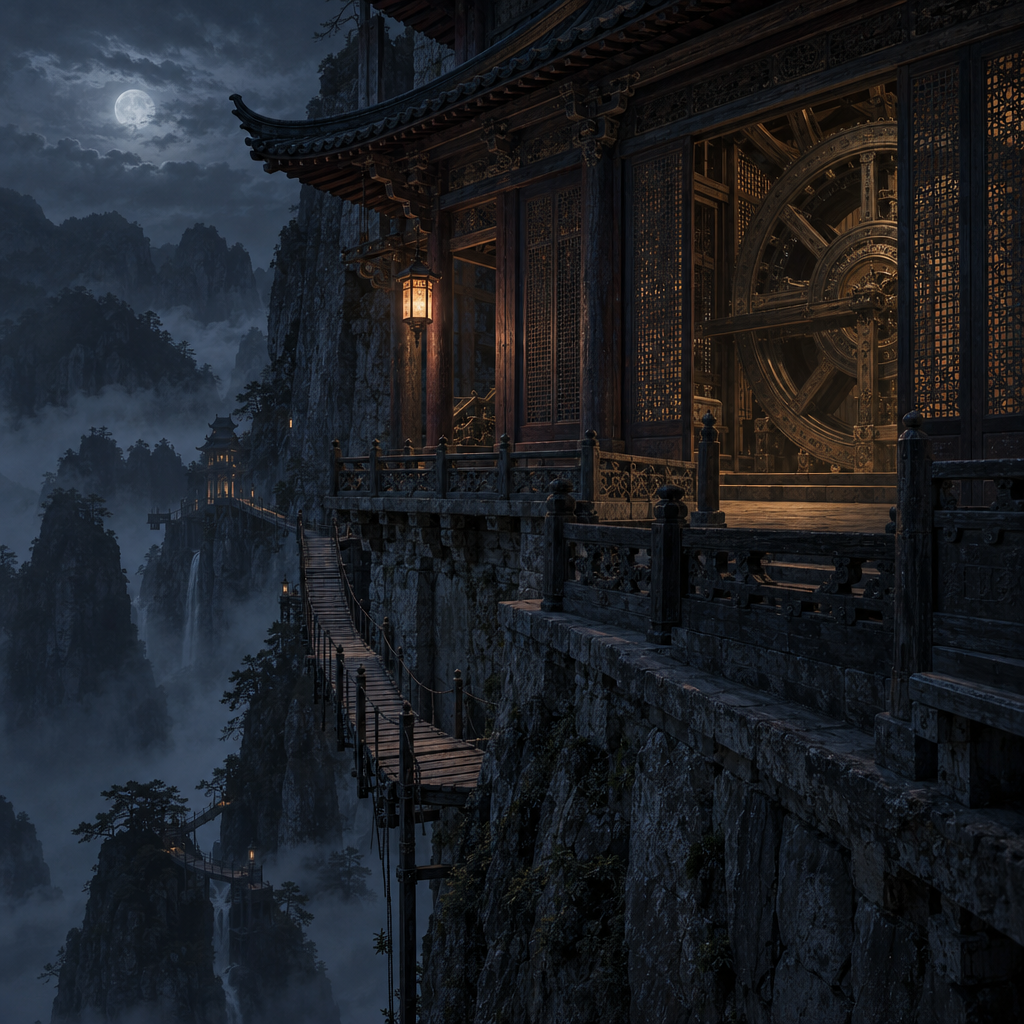
Naoto Sakai heard the vibration through the soles of his boots before he reached the sanctuary.
It was not loud. A patient tremor, like a freight lift trying to start three floors below. The old aerial freight lines had rusted off these mountains before Naoto was born; the valley’s household terminals had gone dark in his father’s youth. But Kurohane’s cliff road still mattered. Every third day, traders, pilgrims, medicine carriers, and mule teams waited below the temple for the Hanging Way to open.
Today there were fifty-three people at the lower gate, Sae had told him.
“Fifty-four,” Naoto said, setting down his tool case beside the sanctuary screen. “A baby counts.”
Sae Umino, twenty-two and always moving too quickly, gave him an offended look. “Then fifty-four. And three pack animals. Abbess Kanzaki says they can’t wait past sunset.”
“They can wait. They may complain while waiting.”
Behind the carved cedar screen, bronze rubbed bronze.
Abbess Miyo Kanzaki stood at the altar with her hands tucked into her sleeves. She was small enough that Naoto had to look down to speak to her, but he did not mistake that for fragility.
“It began at dawn,” she said. “The lower stones moved half a handspan.”
“Settling.”
“They moved back.”
Naoto looked at the screen.
Kurohane had been built into the mountain over centuries. Halls occupied different shelves of rock; stairs, bridges, and galleries had been patched so often that no timber matched another. Beneath the sanctuary lay the route mechanism: bronze teeth and cedar beams that adjusted the Hanging Way’s gates twice a year, before winter and before thaw.
At least, that was what the manuals said.
No route-keeper had seen the whole assembly turn.
Naoto lifted the screen latch. It resisted, then released with a dry click.
Warm air came through the gap, smelling of old oil and wet stone.
He slid the screen aside.
The mechanism filled the dark below the sanctuary.
A bronze wheel taller than a house turned slowly in its timber cradle. Its rim passed through slots in the rock, carrying chains and wooden arms into the mountain. Every few seconds a great tooth engaged a beam, and somewhere in the temple stone grated against stone.
Sae whispered, “It’s moving.”
“Yes.”
“It shouldn’t.”
“No.”
Naoto crouched by the inspection rail. The primary brake was intact. The oil channels were dry but clear. The locking bar lay in its cradle.
Then he saw the empty hole beneath it.
“The safety pin,” he said.
A boot scraped behind him.
Naoto turned.
Three men stood in the sanctuary doorway. Their work gear was too clean for mountain porters. The foremost was Genda Rōhei, broad-faced and grey at the temples, with the calm of a man accustomed to doors opening for him. Behind him came Toru Igarashi carrying a cutting-torch case, and a third man Naoto did not know.
Genda held up a bronze pin as long as Naoto’s forearm.
“This?” he asked.
Naoto stood. “Put it back.”
“We found it in the undercroft.”
“You removed it.”
Genda’s smile barely moved. “We inspected it.”
“You pulled a safety pin from a live route mechanism.”
“I pulled scrap from a dead temple.”
The wheel groaned below them.
Abbess Kanzaki said, carefully, “Leave Kurohane.”
Genda looked past her at the turning bronze. His expression changed. Not wonder. Calculation.
“That alloy,” he said. “Pre-collapse casting.”
Toru kept his eyes on the wheel. “Genda-san, it’s under load.”
“Of course it is.”
Naoto slipped a hand inside his jacket and closed it around the keeper’s seal: an iron disk on a cord, stamped with the old route mark. It fitted the shutdown socket in the summit chamber. Without it, the machine could turn, but not be brought to rest.
Genda noticed.
“Take the seal,” he said.
The unknown man stepped forward.
Naoto threw his tool case. It struck the man’s knee. He folded with a shout. Naoto shoved the sanctuary screen across its track, caught the Abbess by the sleeve, and pushed her toward the side corridor.
“Get below. Tell Sae to close the lower gate.”
“And you?”
“Going up.”
He ran.
The corridor beyond the sanctuary was usually twelve paces long, ending at a stair to the bell gallery. Naoto had swept it a hundred times. Today the floor tilted beneath him. The outer wall folded away with a series of heavy internal blows.
Cold daylight struck him.
The corridor had become a narrow bridge clinging to the cliff face.
To his left, the mountain fell a thousand meters into a blue-grey valley. To his right, the temple wall slid slowly past, shutters and eaves moving like parts of a ship. The bridge curved around the sanctuary, no wider than two boots.
Behind him, Genda shouted, “Sakai!”
Naoto ran harder.
Below, pieces of the Hanging Way were shifting: stone stair segments drawing apart, rails retracting into cliff niches, a covered landing rotating until it faced empty air.
He reached a roofed platform and found the old speaking tube fixed to its wall.
“Sae!”
Her voice burst from the brass mouthpiece below. “Naoto-san? Stone’s moving everywhere!”
“Is the lower gate shut?”
“Abbess-san is doing it. The east stairs are—” A crash swallowed the rest. “Hayaku! Hurry!”
Genda came onto the bridge behind him, careful but fast. The unknown man followed, limping.
Naoto went through the platform’s inner door into a square shaft with a wooden stair climbing its walls. He took the steps three at a time.
At the third landing, the stair swung sideways.
Naoto threw himself through an opening in the wall as the entire flight folded flat against the shaft like a knife blade.
Genda reached for the same landing a second later. His hand caught the rail. The stair beneath him was gone. He hung over the shaft, boots scraping stone.
The unknown man stopped on the far side, stranded.
Naoto backed through the opening.
Genda hauled himself up, face tight now.
“You know this place,” he called.
“I repair it.”
“You can stop it.”
“Put the pin back.”
Genda laughed once. “You think I came here for a pin?”
Naoto shut the door between them and ran.
The next passage rose beneath him until it became a sloping ramp. He caught a handrail, swung upward, and emerged into the hanging cloister: an open square around a courtyard with no ground, only cloud and the far mountain face.
Prayer plaques clattered on their hooks. Floor sections pivoted one after another around central joints.
At the far side, a speaking tube hung loose from its mount.
“Sae!”
“I’m here!” Her voice was thin with panic. “The outside steps are wrong. They’re pointing away from the cliff.”
“How far has the wheel turned?”
“I marked the rim at the sanctuary. It passed the bird carving twice.”
“Twice?”
“Maybe two and a half.”
Naoto looked through the open side of the cloister. Chains, shafts, and counterweights carried the wheel’s motion into the mountain. He could not follow the full arrangement, but he could see what it was doing below.
The Hanging Way was changing in stages.
The first turning had closed old passages and opened others. The second had begun drawing the public route away from its proper line.
“Keep everyone off the road until I ring the summit bell.”
“The bell opens the gate?”
“It tells the gate we’re safe.”
A door banged behind him.
Genda had found another way around.
Naoto crossed the cloister. A floor panel tipped beneath his boots, turning from boards into a wall. He jumped for the far rail, caught it with both hands, and hung above the courtyard.
Toru appeared at the doorway behind him.
“Genda-san said take the keeper!” he called, but he did not advance. He stared at the moving floor. “This isn’t a machine. Machines don’t—”
“It is a machine,” Naoto said, hauling himself higher. “Just not for us.”
“What does that mean?”
The boards settled enough for Naoto to pull himself up.
Then Genda’s voice came from another gallery, closer than it should have been.
“Keep running, Sakai!”
The wheel groaned.
Naoto understood.
Each time he fled, a route formed ahead of him. Not a safe route. Not a kind one. But a route. Behind him, stairs folded, doors moved, floors changed their allegiance.
When Genda had hung in the shaft, the stair had not vanished for Naoto. It had vanished for Genda.
The old word came back to him. Abbess Kanzaki had used it once, speaking of a prohibition no one understood.
Nige-mono.
A thing made for escape.
He ran because Genda was coming.
The passage ahead unwound into a stair curving around the outside of the bell tower. Behind him, Toru stepped onto the cloister floor.
It tipped sharply.
Toru screamed and caught the rail as the whole square of boards rotated upright. Within seconds he was clinging to what had been the floor, now a vertical wall over the open courtyard.
“Genda-san!”
Genda did not answer.
Naoto stopped at the stair’s first turn. Through a gap in the timbers, he saw Genda moving along a lower service ledge toward an undercroft entrance.
He was not following Toru.
He was taking a shortcut.
“Sae!” Naoto shouted into another tube. “Has the wheel passed three?”
A pause. Metal rattled below.
“Almost!”
“Tell the Abbess: no one uses the road at four.”
“I know that!”
“You don’t know how bad it gets.”
“I can see it!” Sae snapped. Then her voice dropped. “The last stair section is hanging over nothing. It keeps extending.”
Cold climbed into Naoto’s stomach.
Old route notes, copied and recopied by keepers who had never understood them, contained one warning: At the fourth movement, the way departs from the mountain.
He had taken it for ceremony.
The Hanging Way would not collapse. It would continue outward, step after step, into open air.
Naoto climbed.
At roof level, the stair flattened into a tiled walk beneath the temple’s dark eaves. Black ridges spread below. Lanterns glowed at the lower gate, where fifty-four waiting people had become a clustered line of helpless lights.
Ahead stood the summit control chamber, a stone room built against the bell tower. Its bronze door bore the keeper’s mark.
Naoto reached it and pulled the latch.
Inside, the shutdown socket waited beside the main brake lever.
Above it hung the alarm-bell rope.
He seized the rope and pulled.
Nothing answered.
He looked up.
The bell hung silent in its frame. Its striker was gone.
Then Genda stepped onto the roof walk beyond the chamber.
In one hand he held the missing striker: a blunt bronze cylinder, bright where fresh cutting had exposed metal. In the other, a pry bar.
“You’ve been busy,” Naoto said.
Genda’s breathing was controlled, but sweat shone on his face.
“I thought it was decorative.”
“It signals the lower gate.”
“Then use your seal.” Genda glanced at the socket. “Or give it to me.”
“You can’t open the route without the bell.”
“I can stop it when I choose.”
“No. You can keep it moving.”
Genda took a step along the narrow roof walk. Behind him, through the open side of the temple, the enormous wheel turned in darkness. Its rim caught lantern light once each revolution.
“Give me the seal,” Genda said. “I’ll lock the public gate. I’ll take what I came for. Nobody needs to die.”
“You removed the pin.”
“I found an opportunity.”
“You made the road lethal.”
“The road was old and unsafe already.”
Naoto looked from Genda to the chamber.
The bell had been the quick answer. Without its striker, he could not signal Sae. He could try the brake, but Genda had the roof walk and the fourth turn was nearly complete.
Behind Genda, the walk bent around the tower toward an old wing sealed for generations: the Chamber of Returning Steps.
Naoto had never entered it. No keeper did. Its doors had no handles on the outside.
The machine did not care who deserved safety. It cared who was fleeing.
Genda had learned enough to hunt him.
Naoto let go of the bell rope.
Genda narrowed his eyes. “What are you doing?”
Naoto stepped out of the control chamber.
“Giving you the road,” he said.
Then he ran at him.
Genda blinked, startled by the change. He raised the pry bar. Naoto did not slow. He seized it with both hands, drove his shoulder into Genda’s chest, and shoved.
Something heavy slipped from Genda’s coat and skittered beneath the eaves.
The roof tiles shifted beneath them.
Genda staggered backward, caught himself, and swung. The bar struck an eave post inches from Naoto’s head. Naoto ducked, grabbed Genda’s coat, and dragged him toward the curved walk.
“Get away from me!” Genda shouted.
Naoto drove him back another step.
The roof walk moved.
Tiles slid under their feet, slowly but with irresistible force. A section behind Naoto buckled upward, closing off the control chamber. Ahead of Genda, the walkway straightened into a narrow run beneath the eaves.
Genda saw it.
“No,” he said.
Naoto advanced.
“Omae ga nigeru ban da,” he said. Now it is your turn to run.
Genda fled.
He did not choose to. The roof behind him tilted; Naoto was close enough to catch his collar. Genda ran along the path the temple gave him, past shuttered windows and black wooden pillars.
Naoto followed.
Doors opened ahead, one after another.
Genda crossed the first threshold. A stair unfolded before him, descending through a chamber lined with old bronze plates. He took it at speed. Naoto followed close enough that Genda could hear his boots.
The chamber rotated.
Walls became floors. The stair flattened. Genda scrambled across it, slipping on dust.
“This is your doing!” he shouted.
Naoto said nothing.
The bronze plates showed worn figures in procession: some walking forward, some turned back, some with arms raised against a closing door.
Genda reached the far side.
There was only one exit.
A bronze door.
He struck it with the pry bar. “Open!”
Behind him, Naoto entered the chamber.
The wheel gave a deep final note from within the mountain.
Genda backed against the door. “Sakai. Listen. You need me outside. You need the striker.”
Naoto came forward.
Genda swung wildly. Naoto caught his wrist, twisted, and felt the bar fall. Genda shoved him away and clawed at the door seam.
The wheel completed its fourth revolution.
The bronze door opened inward.
Beyond it was darkness and the first pale curve of stone steps descending where no stair should have fit.
Genda stumbled through.
Naoto caught the back of his coat at the threshold.
For an instant Genda turned toward him. His control was gone. He was simply afraid.
“Don’t,” he said.
Naoto released him.
The door closed.
It shut quietly enough that the click of its bronze latch was worse.
The chamber stopped moving.
All through Kurohane, wood settled. Chains slackened. The great wheel scraped once against its cradle and became still.
Naoto stood with one hand against the bronze door.
From below, faint through stone and shaft, Sae’s voice came up a speaking tube.
“Naoto-san?”
He turned away from the door.
“The wheel stopped,” she said. “The Hanging Way is back.”
“Keep the gate shut until you see the cliff rail aligned.”
“I can see it.” Her breath caught. “It’s normal.”
“Then open it.”
By sunset, the procession was crossing.
The first mule stepped onto the restored Hanging Way with its ears laid back. Its handler followed, then a woman carrying medicine cases, then pilgrims and traders, moving cautiously along the familiar stone path around the mountain.
Naoto watched from the sanctuary rail while Sae reset the speaking tubes and Abbess Kanzaki replaced the carved screen over the motionless wheel.
The bronze safety pin lay in its proper place. Naoto had retrieved it from beneath the eaves and put it back himself.
Sae looked toward the sealed lower corridors. “What about Toru?”
“Abbess sent people by the western stairs,” Naoto said. “They got him off the cloister wall.”
“And Genda?”
Abbess Kanzaki’s hands paused on the screen latch.
“The Chamber of Returning Steps is closed,” she said, formal again, almost liturgical. “No person will reopen it.”
“He has the bell striker,” Sae said.
“We will cast another.”
Naoto looked at the dark seam in the sanctuary floor where the mechanism vanished into rock.
Then, from far beneath them, came one measured knock on bronze.
Sae inhaled.
Abbess Kanzaki closed the screen.
Naoto did not answer.